

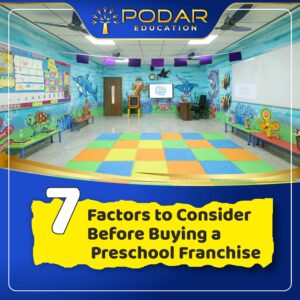
Investing in a preschool franchise is a major financial and emotional commitment. With dozens of brands flooding the Indian market, separating the premium partners from the opportunistic ones can be difficult.
Before you sign a franchise agreement, you must evaluate the brand across these 7 critical factors to ensure long-term success.
- Brand Reputation and Legacy
In education, legacy matters. A brand with a history of excellence builds instant trust with young parents. Evaluate the brand’s footprint, online reviews, and market perception.
Real Example: Franchisees operating under the Podar Little Maestros banner consistently report 30-40% higher walk-ins compared to newer, unknown brands simply because parents already recognize and respect the Podar educational legacy.
- Depth and Quality of Curriculum
Today’s parents are highly educated and deeply involved in their child’s development. They will ask detailed questions about your pedagogy.
- Is the curriculum aligned with the National Education Policy (NEP) 2020?
- Does it focus on holistic, play-way, and experiential learning rather than rote memorization?
- Are you provided with daily lesson plans, or just a broad syllabus?
- Comprehensive Training Support
Your teachers are the face of your business. If the franchisor does not invest heavily in training, your quality will suffer. Look for brands that offer rigorous initial induction training, regular upskilling workshops, and operational training for you (the owner).
Real Example: A Bangalore franchise noticed a massive improvement in classroom management and reduced teacher attrition by 20% after implementing the franchisor’s structured, quarterly pedagogical training programs.
- Realistic ROI and Financial Transparency
Beware of brands promising overnight returns. A trustworthy franchisor will provide a realistic Franchise Disclosure Document (FDD) or financial projection. Always ask:
- What is the historical break-even timeline for centers in similar cities?
- What are the hidden costs (e.g., mandatory software renewals, hidden marketing levies)?
- What is the expected net margin at 50%, 75%, and 100% capacity?
- Robust Marketing & Lead Generation Support
A great school with no students is a failed business. Evaluate the franchisor’s marketing muscle. Do they run national campaigns? Do they provide you with high-quality social media creatives, localized SEO strategies, and lead management CRM software?
Real Example: Centers utilizing centralized, data-driven digital ad campaigns provided by top franchisors routinely see 2x the lead generation compared to centers left to manage their own ad accounts.
- Territory Exclusivity & Location Availability
You do not want to compete with your own brand. Ensure the franchise agreement includes a strict exclusivity clause, guaranteeing that another branch of the same franchise will not open within a specific radius (usually 3-5 kilometers, depending on the city’s density).
- Vision for Scalability
If your first center is a success, you will likely want to open a second. Does the franchisor encourage multi-unit ownership? A good franchise model should allow you to scale your wealth over the next decade.
Conclusion
Buying a franchise is like entering a marriage; it requires alignment in values, transparency, and mutual effort. Evaluating a brand against these seven factors is the difference between an uphill struggle and a flourishing, profitable school.